
Before you drill: pressure, hardness and your plumbing code
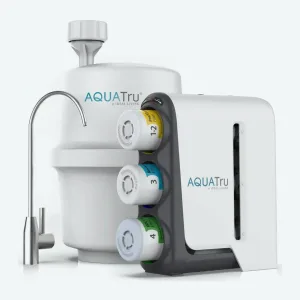
Read the limits in the manual before the box is open. I went through the installation manuals and data sheets of the four under-sink systems in our reverse osmosis comparison. The two that publish feed-water limits set nearly the same ones.
| Limit | Aquasana SmartFlow | AquaTru Under Sink |
|---|---|---|
| Water pressure | 40–80 psi | 40–85 psi |
| Water temperature | 40–100°F | 39–100°F |
| Total dissolved solids | 1,000 ppm max | 1,500 mg/L max |
| Hardness | 10 gpg max | 10 gpg (171 mg/L) max |
| Chlorine | 3 ppm max | Under 2 ppm |
| pH | 4–10 | 3–11 |
| Iron, manganese, sulfide | Not given | Under 0.1 mg/L |
Below 40 psi, Aquasana suggests a booster pump. Cold water costs output too. UNL Extension puts the drop at 1 to 2 percent for every degree below 77°F, so 45°F well water makes about half as much. Above 10 gpg of hardness, AquaTru warns that scale plugs the membrane quickly unless the water is softened first.
Then check where you live. Massachusetts requires a licensed plumber for the install and does not permit saddle valves, Aquasana's manual notes, citing the state plumbing code 248 CMR. Minnesota prohibits saddle fittings on drain pipes, per the Minnesota Department of Health. Both rules hit the part most kits use for the drain.
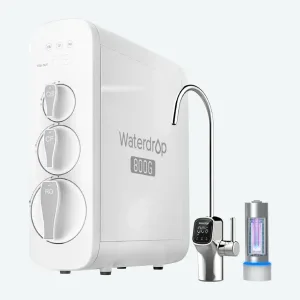
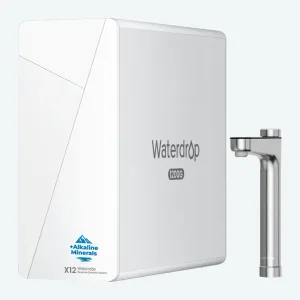
The two Waterdrop systems are tankless and need a power outlet under the sink. All four need a drain line and a faucet hole.
RO filter installation, step by step
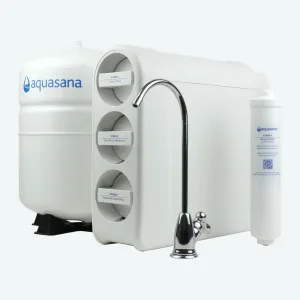
The steps below follow the Aquasana SmartFlow manual, the most detailed of the four. Other kits use the same parts with different fittings and tubing colors, so keep your own manual open.

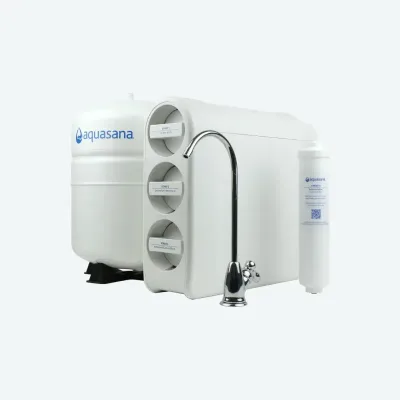
Start by shutting off the cold water under the sink and opening the kitchen faucet to release pressure. Set the unit and the tank in the cabinet before connecting anything, to check that every tube reaches. Aquasana's tool list: a drill with a 1/4-inch bit, an adjustable wrench, a Phillips screwdriver, a utility knife, a tape measure, a pencil, a bucket, safety glasses and household bleach.
Step 1. Mount the RO faucet
The faucet needs a hole of at least 1/2 inch in the sink or countertop. Aquasana suggests reusing the hole of a sink sprayer or soap dispenser. Drilling a new one is where both Aquasana and AquaTru send you to a professional.
Step 2. Fit the drain saddle above the trap
The drain saddle clamps onto the sink drain pipe above the P-trap. Aquasana says not to use the pipe that also serves a garbage disposal. Drill a 1/4-inch hole through one side of the pipe only, line the foam gasket up with it, and tighten the two halves without overtightening.
Step 3. Add the feed water adapter
With a bucket under it, disconnect the faucet supply line from the cold shut-off valve, thread the adapter onto the valve and reconnect the line on top. The adapter's own small valve feeds the RO unit. The kit runs on 1/4-inch tubing, and Aquasana says you need quick-connect adapters if your tubing is 3/8 inch.
Step 4. Place the unit and sanitize the tank
Put the unit where you can reach it for filter changes, and the tank stand next to it. Before the tank goes on, Aquasana has you wrap its thread four to five times with plumber's tape and add 3 mL of bleach to the tank tube with the supplied dropper. The flush in step 6 rinses it out.
Step 5. Connect the tubing
Cut tubing square with a sharp blade, mark 0.625 inch from each end and push it in until the mark reaches the fitting. Aquasana color-codes the lines: white from the feed adapter, yellow to the tank, blue to the faucet and red to the drain. Its kit runs the red line straight to the drain saddle. An air gap adapter is a separate part with its own manual, installed at this point.
Step 6. Pressure test and flush
Turn the cold water back on with the RO faucet closed. The tank fills in about two hours. Check every fitting for drips, then open the RO faucet and let the tank run empty. Aquasana repeats that three times and says not to drink the flushed water. After the third tank, the next fill takes 1 to 3 hours, and the system is ready for regular use.
Air gap: required in some states, optional in some kits
An RO system sends its reject water to the drain. A direct connection would let a backed-up drain reach the system. The Minnesota Department of Health requires an air gap or an air gap device on every under-sink RO install and calls it cross-connection control that protects the drinking water supply.
Its rules are specific. Where the drain line ties into the trap under the sink, the air gap has to sit above the sink rim, which in practice means an air gap faucet. If the trap clogs, the reject water spills out of the faucet's weep hole above the flood level instead of flowing back. The faucet or device has to meet IAPMO PS 65, NSF/ANSI 58 or ASME A112.1.3. Check valves and under-sink air breaks, sometimes sold as a “backflow preventer” or “air gap adaptor,” are not approved there.
The kits read differently. Aquasana's manual says certain codes call for “either an air gap faucet or a backflow preventer” and leaves the choice to your local code. It sets the gap at two pipe diameters or 1 inch, whichever is larger. Waterdrop's G3P800 manual titles its faucet step “Non-Air Gap Faucet.” Before buying, ask your local building department whether an air gap faucet is required. If it is, pick a system that comes with one or budget for it.
Thirty minutes on the product page, six hours in the manual
Waterdrop promises “Easy Installation in 30 Minutes” for both of its tankless systems, and its G3P800 page adds “no plumbing skills required.” AquaTru takes the opposite line for its under-sink model: it recommends a certified plumber because installation “requires drilling into your pipes under the sink.” Aquasana sits between, with basic plumbing knowledge recommended and a professional if you have to cut pipe or drill.
The work itself is only part of it. With a tank system, the flush in step 6 takes about six hours by Aquasana's timings, three tanks at roughly two hours each, before the first fill for drinking. A tankless unit has no tank to fill and empty. The G3P800 manual describes automatic 20-second flushes after two hours of running time and after a power cut.
Changing RO filters and the membrane
Filter changes are the job you will repeat. Each brand sets its own schedule, and the prefilters come due two to four times as often as the membrane. Membrane schedules across brands are compared in how often to change RO filters.
| System | What to replace and when | Filters a year |
|---|---|---|
| AquaTru Under Sink Reverse Osmosis | Pre/carbon 6 months or 360 gal, VOC 12 months or 360 gal, RO 24 months or 1,200 gal | $130 |
| Aquasana SmartFlow Reverse Osmosis | Carbon filters 6 months or 250 gal, membrane 12 months, remineralizer 6 months | $310 |
| Waterdrop G3P800 Reverse Osmosis System | CF 6 months or 550 gal, CB 12 months or 1,100 gal, RO 24 months or 2,200 gal (brand figures) | $160 |
| Waterdrop X12 Reverse Osmosis System | F1A 12 months or 1,100 gal, F2 6 months or 550 gal, RO cartridge 24 months or 2,200 gal (brand figures) | $175 |
On the SmartFlow the replacement manual runs like this: close the inlet valve and the tank valve, open the RO faucet until it stops, twist out the old cartridges and turn the new ones in by a quarter turn. Aquasana warns that skipping the pressure release can damage the system for good. Then it asks for the same three-tank flush as a new install, 1 to 3 hours per refill.
Membranes clog with scale and with microbes, which UNL Extension calls bio-fouling. UNL advises disinfecting the system regularly with the manufacturer's products. A fouled membrane can sometimes be cleaned if caught early, while a torn one has to be replaced. A damaged membrane is hard to spot, so UNL suggests testing the water from time to time. In hard water, a softener ahead of the RO system can extend membrane life.
Check that it works after the install
Many RO faucets and units read out TDS, total dissolved solids. Waterdrop's manual expects 90% or more TDS rejection once the system is fully flushed, and UNL calls a TDS monitor one indicator that the membrane is working. Our TDS guide shows how to check the membrane with a TDS meter. TDS says nothing about lead, arsenic or nitrate on its own, so it is not a safety reading.
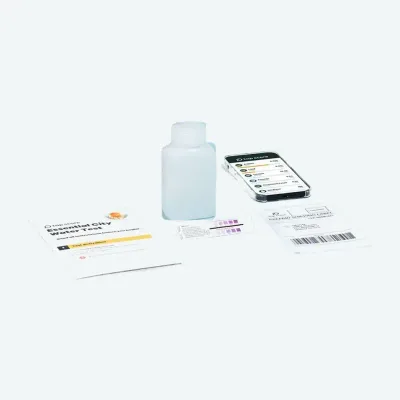
For the contaminant you bought the system for, test the treated water itself. AquaTru's data sheet asks owners to have the treated water analyzed for arsenic to confirm the system is working. Aquasana's manual suggests checking nitrate every 3 to 4 months and puts a nitrate test in the box. Home and lab kits are compared in our water test kit guide. A certification shows what a system can reduce, and those contaminants are not necessarily in your water. This guide is general information. See our health disclaimer.
When a plumber or a countertop unit makes more sense
Call a plumber if you live in Massachusetts, if the countertop is stone or the sink has no spare hole, or if your code requires an air gap faucet and you would rather not route the drain lines yourself. Waterdrop runs an installer locator on its site, and AquaTru's support team guides installs by phone.
Filters are the larger long-run reverse osmosis system cost: $130 to $310 a year for the four systems here, against system prices of $395 to $1,299 (brand prices checked Oct 13, 2026). A plumber's fee depends on your area, and none of the four brands publishes one.
Renters, or anyone who can't drill, can skip all of this. A countertop RO unit sits next to the sink and needs no plumbing: you fill its feed tank by hand. Six are compared in our countertop reverse osmosis guide. Whole-house RO is a different project. UNL Extension notes that point-of-entry units cost more to buy, install and run than under-sink ones. How the membrane itself works is in what is reverse osmosis.
Questions people ask
How much does it cost to get an RO system installed?
None of the four brands in our comparison publishes an installation price, and plumber rates vary by area. Doing it yourself costs tools and time: Aquasana's kit includes the faucet, the drain saddle and the feed valve. Over the years, filters cost more than the install, $130 to $310 a year for these four systems (brand prices checked Oct 13, 2026).
Is it difficult to change RO filters?
On twist-in cartridge systems such as Aquasana's, no. You release the pressure, turn out the old cartridges and turn in the new ones. The slow part is the flush afterward, three tanks at 1 to 3 hours per refill. Prefilters come due every 6 to 12 months and membranes every 12 to 24 months on the four systems we compare.
Do I need an air gap faucet for a reverse osmosis system?
It depends on your local plumbing code. Minnesota requires an air gap or an air gap device on every under-sink RO install and does not accept check valves. Aquasana's manual says certain codes require an air gap faucet or a backflow preventer. Ask your local building department before you buy.
Can you install a reverse osmosis system in a basement?
Aquasana's manual asks for an indoor spot away from direct sunlight and freezing, with cold water at 40 to 100°F and 40 to 80 psi. A basement can meet that, but the tubing has to reach the faucet upstairs, and colder water slows output. UNL Extension estimates 1 to 2 percent less for every degree below 77°F.
Ready to pick one?
I compare 20 RO systems on certification, yearly cartridge cost, warranty and owner reviews. These score highest right now.