
How does reverse osmosis work?
Most explanations of what is reverse osmosis start with plain osmosis. Put salty and fresh water on two sides of a membrane that passes water but holds back dissolved salts, and water moves on its own toward the salty side, as University of Nebraska–Lincoln Extension describes it.
Reverse osmosis pushes the other way. Pressure on the salty side forces water back through the membrane, and most of what was dissolved in it stays behind. CDC describes a process that “reverses the natural flow of water.” That reversal is the whole reason for the name.
Osmosis vs reverse osmosis
| Osmosis | Reverse osmosis | |
|---|---|---|
| Which way water moves | From the dilute side into the concentrated side | From the concentrated side out to the dilute side |
| What drives it | Nothing, it happens on its own | Water pressure that beats the osmotic pressure |
| What you end up with | Saltier water gets diluted | Treated water on one side, brine on the other |
Two streams leave the membrane. EPA WaterSense calls the treated water “permeate” and the reject water “concentrate” or “brine.” The brine carries the held-back salts and metals to the drain.
A membrane's rejection rate is a percentage, not a guarantee. UNL Extension works through nitrate: at 85% rejection, 40 mg/L in the tap water comes out at 6 mg/L, but 80 mg/L only comes down to 12 mg/L, still above the federal limit of 10 mg/L. The starting level matters.
Line pressure has to beat the osmotic pressure plus the tank's back pressure. Where house pressure is low, a booster pump is added.
The stages inside a home RO system
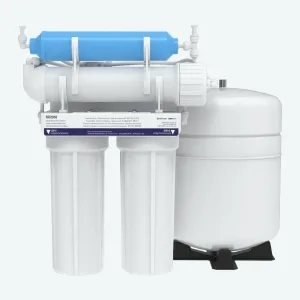
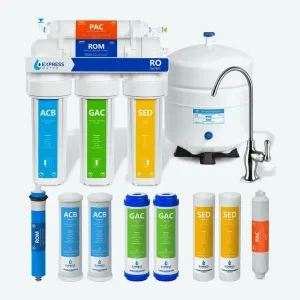
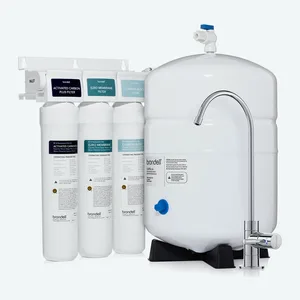
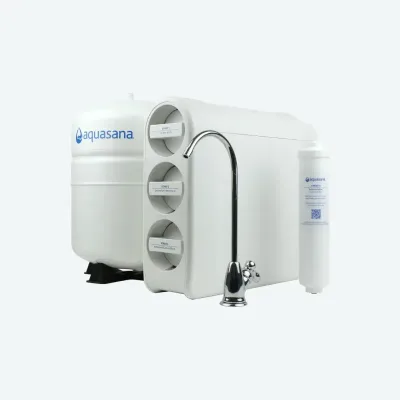
UNL Extension lists the usual parts of a home unit as a prefilter, the RO membrane, a flow regulator, a post-filter, a storage tank and a separate faucet at the sink, so the treated water goes to drinking and cooking only. Countertop units skip the plumbing, and most have a tank you fill by hand. We compare them in countertop reverse osmosis systems.

| Stage | Part | What it does | Why it's there |
|---|---|---|---|
| 1 | Sediment prefilter | Catches silt and other particles | Particles foul the membrane |
| 2–3 | Carbon prefilter | Reduces chlorine and some solvents and pesticides | Chlorine wears down thin-film membranes |
| 4 | RO membrane | Holds back dissolved salts and metals | The only reverse osmosis step |
| Drain line | Flow regulator | Sets how much water rinses the membrane | Controls the drain-to-drink ratio |
| Tank | Pressurized tank, 2 to 5 gallons | Stores treated water | The membrane is slow, the tap is not |
| 5 | Carbon post-filter | Takes out leftover taste and odor | Water can pick up taste in the tank |
The stage count on a box adds up those cartridges. A 5-stage unit has more cartridges to replace than a 3-stage one, but the reverse osmosis step is still one membrane.
The membrane is slow. UNL puts household membranes at 10 to 35 gallons a day, which is why most systems fill a tank. The two common membrane types differ in one way that matters: thin-film composite (TFC) membranes reject more but deteriorate in chlorinated water, so they need the carbon prefilter on city water. Carbon on its own, without a membrane, is covered in my activated carbon filter guide. Cellulose acetate (CA or CTA) membranes tolerate chlorine.
Some newer units skip the tank. EPA's WaterSense specification covers both kinds: tank systems are scored by an efficiency rating, tankless ones by a recovery rating, and both need an automatic shut-off device.
Why an RO system sends water down the drain
The brine stream isn't a leak. It rinses the membrane, and it's where most of the water goes. EPA WaterSense says a typical point-of-use RO system sends five gallons or more down the drain for every gallon of treated water, and some inefficient units send up to 10.
In the supporting statement for its specification, EPA puts typical efficiency ratings at 10 to 20%. The spec's own formula for the drain ratio is (100 − rating) ÷ rating, so that range works out to 4 to 9 gallons down the drain per gallon you keep. UNL gives a 20 to 30% recovery rate for most household designs.
EPA released its WaterSense specification for RO systems in November 2024. A labeled unit needs an efficiency rating of at least 30%, which is 2.3 gallons or less per gallon, plus certification to NSF/ANSI 58. EPA estimates that a labeled unit uses more than 3,100 gallons less water a year than a typical one. The RO waste water calculator shows which systems clear that bar.
On a septic system, all that drain water is extra load, UNL notes.
What RO reduces, and what gets through
CDC lists parasites, bacteria and viruses, plus lead, copper, chromium, chloride and sodium, as what reverse osmosis takes out of water. RO may also reduce arsenic, fluoride, radium, sulfate, nitrate, phosphorus, calcium, magnesium and potassium, CDC adds, and it tells buyers to check the system's label for the specific chemicals.
For PFAS, EPA named reverse osmosis and nanofiltration among four best available technologies for meeting its 2024 drinking water limits, next to granular activated carbon and anion exchange.
| In the water | RO result | Watch for | Source |
|---|---|---|---|
| Lead, copper, chromium | Reduced | The listing should name the metal | CDC |
| Sodium and chloride | Reduced | The same process desalinates seawater | CDC, USGS |
| Nitrate, arsenic, fluoride, radium | May be reduced | What comes out depends on what goes in | CDC, UNL |
| PFAS | Best available technology at plant scale | Look for PFOA and PFOS on the home unit's listing | EPA |
| Chlorine, trihalomethanes, many solvents | Mostly the carbon stages' job | Carbon cartridges need replacing on time | UNL |
| Hydrogen sulfide | Passes through | The rotten-egg smell stays | UNL |
| Bacteria, viruses, parasites | Held back | Feed the unit coliform-free water only | CDC, UNL |
Not necessarily in your water. This table says what RO can reduce, not what your tap contains. A water test or your utility's yearly report tells you that.
Federal, state and local laws don't regulate home RO systems, UNL points out, and the industry is self-regulated. The check that works is the certification listing. CDC names NSF/ANSI 58 as the reverse osmosis standard and suggests looking a product up in the NSF database to see what it's certified for.
A TDS meter shows a big drop after an RO unit, and the WaterSense spec requires at least 75% TDS reduction in its membrane life test. TDS counts dissolved minerals and salts, though. A low reading doesn't show the water is free of lead, PFAS or germs. Distillation is the other home method that strips dissolved minerals, and the two are compared in reverse osmosis vs distilled water.
Reverse osmosis vs regular filtration
CDC sorts home filters by pore size. An RO membrane's pores are about 1,000 times smaller than a microfilter's.
| Filter type | Typical pore size | Germs | Chemicals |
|---|---|---|---|
| Microfiltration | About 0.1 micron | Parasites, some bacteria | Not lead or arsenic |
| Ultrafiltration | About 0.01 micron | Parasites, bacteria, some viruses | No |
| Nanofiltration | About 0.001 micron | Parasites, bacteria, viruses | Some |
| Reverse osmosis | About 0.0001 micron | Parasites, bacteria, viruses | Lead, copper, chromium, sodium, chloride and more |
Pitcher and fridge filters typically use carbon to make water taste better or to reduce metals like lead, CDC says, and they aren't designed for germs.
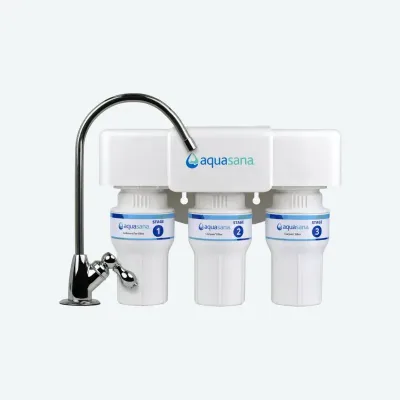
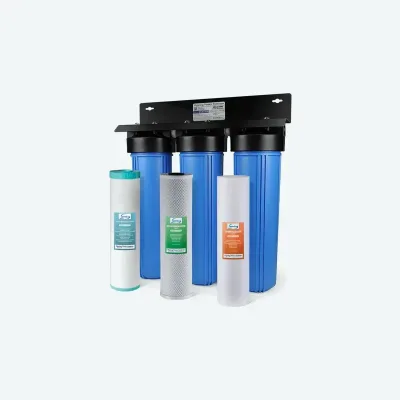
A 3-stage under-sink filter is usually sediment plus carbon blocks with no membrane. It sends no water to the drain. Nitrate and sodium aren't on the list of what carbon handles in UNL's guide, though, and that's where RO earns its drain water.
The certification standards follow the same split. CDC lists NSF/ANSI 42 for taste and odor, 53 for cyst reduction, 58 for reverse osmosis and 62 for distillation. If your test shows only chlorine taste or lead, a carbon unit certified for it may do. Under-sink filters compares those.
What reverse osmosis does not do
It doesn't make an untested well drinkable. RO can hold back microorganisms, but UNL Extension doesn't recommend it for that job: only coliform-free water should go in, because bacteria wear down the membrane and can slip through pinhole leaks. For germs, CDC points to UV treatment with prefiltration.
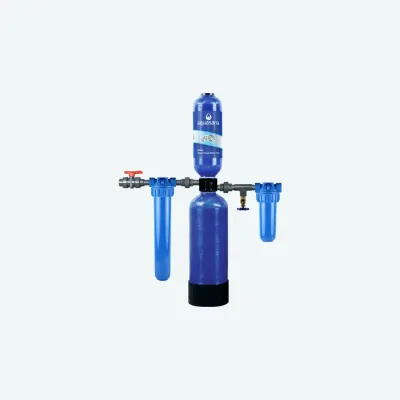
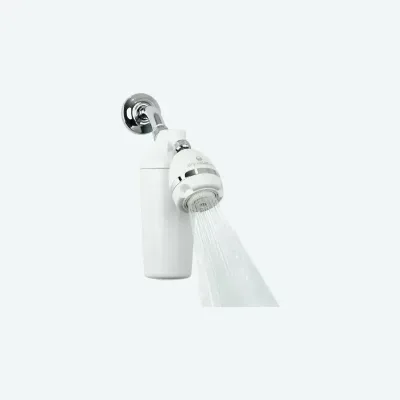
It doesn't treat the whole house. The WaterSense spec covers point-of-use systems at one tap and leaves out point-of-entry RO. Hardness, iron or chlorine in the shower are whole-house filter problems.
It slows down in cold water. Output drops 1 to 2% for every degree below 77°F, so 45°F well water gives about half as much, UNL says.
It doesn't run itself. Cartridges need regular replacement, and microorganisms can foul the membrane, so UNL advises disinfecting the system regularly. Treated water can also be more corrosive than untreated water, which is why RO units get their own faucet and plumbing.
It doesn't settle whether low-mineral water is better or worse to drink. That's a health question for a separate guide. Nothing here is medical advice, see the health disclaimer.
What is reverse osmosis used for outside the kitchen?
The same process runs at city scale. USGS calls reverse osmosis an effective way to desalinate saline water: salt molecules don't get through the membrane, smaller water molecules do. It costs more than other methods, USGS adds. An “RO plant” is that kind of facility.
Utilities can also use RO or nanofiltration for PFAS, but EPA notes the brine then has to be discharged to surface water or sewers under a permit.
Test your water before you buy one
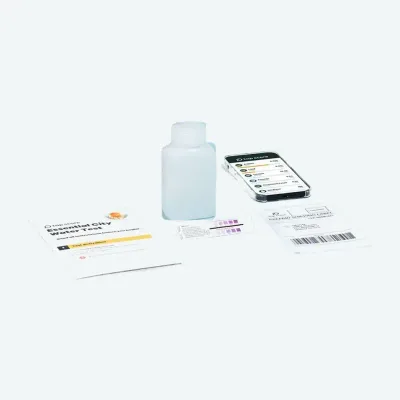
CDC's advice is short: test your water and choose a system for the germs or chemicals you're worried about. On city water, start with your utility's yearly Consumer Confidence Report, as UNL suggests. On a private well, nobody tests for you. Water test kits compares lab tests with home strips.
If the results show nitrate, arsenic, high sodium or PFAS above the limits, RO is the type of system built for them. The RO systems I compare are scored on the certification listing, yearly cartridge cost and warranty, and each one links to its NSF or WQA listing so you can match it against your test.
Questions people ask
Is boiled water the same as RO water?
No. Boiling kills most disease-causing germs, but EPA notes that boiling or disinfection will not destroy heavy metals, salts and most other chemicals. RO works the other way round: it holds back dissolved salts and metals but isn't meant to make contaminated water drinkable. Distilled water is a third thing, boiled and then collected as it cools.
Does reverse osmosis filter out bacteria?
Yes, in principle. CDC lists bacteria, viruses and parasites among what an RO filter holds back. UNL Extension still advises feeding an RO unit coliform-free water only, because bacteria deteriorate the membrane and contamination can get through pinhole leaks. For a well with bacteria, CDC's option is UV treatment with prefiltration ahead of anything else.
Does reverse osmosis reduce PFAS?
Yes. EPA named reverse osmosis among four best available technologies for meeting its 2024 PFAS limits, with nanofiltration, granular activated carbon and anion exchange. That ranking is for treatment plants. For a home unit, look for PFOA and PFOS on its NSF/ANSI 58 listing, as the models in best reverse osmosis systems show.
Does reverse osmosis take out minerals?
Yes. CDC lists calcium, magnesium and potassium among what RO may reduce, along with sulfate and fluoride. That's why a TDS meter drops so far after an RO unit. Whether low-mineral water matters for your health is a separate question, covered in is reverse osmosis water good for you.
Is there anything better than reverse osmosis?
No single home system covers everything. CDC lists filtration, distillation, UV treatment and water softeners, each aimed at different germs or chemicals. Distillation uses more energy and takes longer than RO, UV with prefiltration handles germs but not chemicals, and a softener targets calcium and magnesium. The better pick is the one your water test points to.
Ready to pick one?
I compare 20 RO systems on certification, yearly cartridge cost, warranty and owner reviews. These score highest right now.