
One city, several hardness levels: what utility reports show
Hardness comes from the ground. USGS explains that water moving through soil and rock dissolves calcium and magnesium, so a city that draws on several rivers, reservoirs or wells can send water of different hardness to different neighborhoods. We read the latest yearly water quality report for each of 44 US cities, and 27 of them print a hardness figure.
| City | Average | Range | In gpg | USGS class |
|---|---|---|---|---|
| Salt Lake City | By source | 136–571 | 8.0–33.4 | Hard to very hard |
| Santa Barbara | By source | 44–464 | 2.6–27.1 | Soft to very hard |
| Indianapolis | 317 | 148–460 | 8.7–26.9 | Hard to very hard |
| Palm Springs | By source | 30–340 | 1.8–19.9 | Soft to very hard |
| San Jose | By source | 99–288 | 5.8–16.8 | Moderately hard to very hard |
| Las Vegas | 280 | Average only | 16.4 | Very hard |
| San Diego | By source | 145–243 | 8.5–14.2 | Hard to very hard |
| Los Angeles | By source | 103–236 | 6.0–13.8 | Moderately hard to very hard |
| Corpus Christi | 236 | Average only | 13.8 | Very hard |
| Houston | 135.5 | 43.5–229 | 2.5–13.4 | Soft to very hard |
| Tampa | 211 | Average only | 12.3 | Very hard |
| Washington, DC | 139 | 84–194 | 4.9–11.3 | Moderately hard to very hard |
| Ann Arbor | 126 | 74–180 | 4.3–10.5 | Moderately hard to hard |
| Oakland | By source | 14–160 | 0.8–9.4 | Soft to hard |
| Berkeley | By source | 14–160 | 0.8–9.4 | Soft to hard |
| Sacramento | 83 | 15–154 | 0.9–9.0 | Soft to hard |
| Memphis | 48 | 14–150 | 0.8–8.8 | Soft to hard |
| Fresno | 129 | 87–150 | 5.1–8.8 | Moderately hard to hard |
| Detroit | 107 | 96–142 | 5.6–8.3 | Moderately hard to hard |
| Cincinnati | By source | 126–140 | 7.4–8.2 | Hard |
| Louisville | 128 | Average only | 7.5 | Hard |
| Austin | 93 | 70–126 | 4.1–7.4 | Moderately hard to hard |
| Columbus | By source | 98–125 | 5.7–7.3 | Moderately hard to hard |
| Denver | 105 | 55–124 | 3.2–7.3 | Soft to hard |
| San Francisco | 62 | 8.1–112 | 0.5–6.5 | Soft to moderately hard |
| New York | 32 | 18–100 | 1.1–5.8 | Soft to moderately hard |
| Portland | By source | 7–80 | 0.4–4.7 | Soft to moderately hard |
In 22 of the 23 cities whose report prints a range, the range crosses at least one USGS class line. Houston runs from 43.5 to 229 mg/L, soft at one end and very hard at the other. In Los Angeles the number depends on the supply: water from the Los Angeles Aqueduct Filtration Plant averages 103 mg/L, water from MWD’s Diemer plant 236 mg/L, and the utility’s report shows which parts of the city get which.
A city average describes the system, not your tap. USGS itself says its national hardness map is regional only and points you to the local utility, health agency or softener dealer for the figure at your home. Ask which source serves your address, or test the tap.
Free hard water tests: your utility, a free strip, a dealer visit
Start with the utility’s yearly report, also called the Consumer Confidence Report. Hardness has no federal limit, and it isn’t on EPA’s list of secondary standards for taste and appearance either, so a report doesn’t have to include it. For 17 of the 44 cities, the report we read had no hardness figure, among them Chicago, San Antonio and Miami. If yours is one of them, call the utility and ask.
Morton Salt mails a free water hardness test strip to anyone who signs up with an email address. You run it under the tap and compare the color.
Water treatment dealers often test at home for free. The University of Nebraska–Lincoln Extension says these tests mostly cover nuisance problems such as hardness, pH and iron, and warns that some dealers use them to pressure people into equipment they don’t need. Penn State Extension advises a third-party test before you buy a softener: an independent lab test “is not expensive and will protect you from being oversold.”
Water test kit for hardness: strips, a drop-count kit or a lab
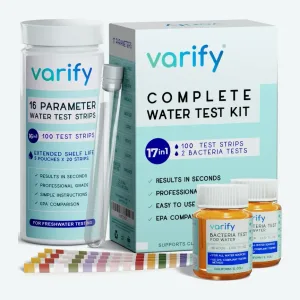
Strips are the quickest home test. You dip one, wait and match the pad to a color chart, which gives a band rather than an exact figure. Hardness is usually one pad among several, often next to iron, pH and chlorine. Varify’s 17-in-1 kit, for example, is $29.99 (checked Oct 14, 2026) for 100 strips (brand figures).
A drop-count kit gives a number. In Hach’s Model 5-B total hardness kit, you fill the sample tube, add the reagents, then add titrant one drop at a time until the sample turns blue. Each drop is 1 gpg (17.1 mg/L), the range is 1 to 30 gpg, and one kit holds about 100 tests (Hach figures). A number to the grain is what softener sizing works from.
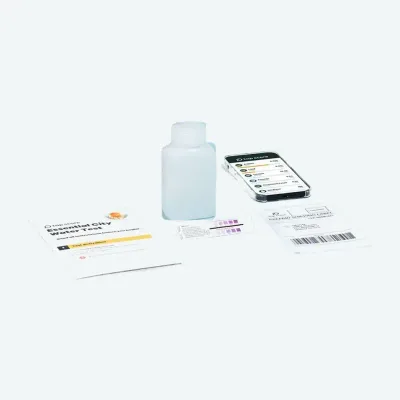
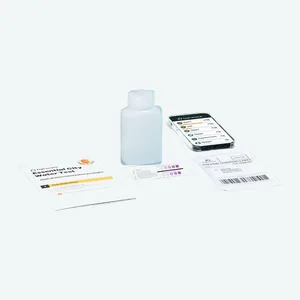
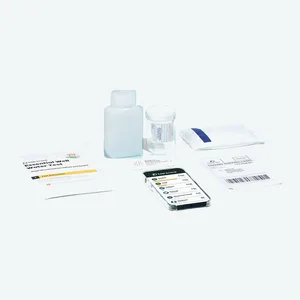
A lab reports hardness calculated from measured calcium and magnesium. Tap Score sells a hardness-only lab test and includes hardness in every Essential and Advanced panel (brand page). Tap Score’s Essential City Water Test lists hardness in mg/L and gpg plus the Langelier Saturation Index, a scaling indicator, among 49 analytes, iron and lead included. A panel makes sense when you also want those numbers, or before you buy a softener.
| Option | What you get | Time | Cost |
|---|---|---|---|
| Utility report, free strip | The utility’s average and range; a color band | Same day | Free |
| Test strips | A color band for total hardness, usually with other items | About a minute (brand figure) | $29.99 for 100 strips that read 17 items (Varify) |
| Drop-count kit | A number in gpg, one drop per grain | At the sink | Hach 5-B: about 100 tests, 1 to 30 gpg |
| Mail-in lab test | A number in mg/L and gpg, from measured calcium and magnesium | 5 business days at the lab (brand figure), plus shipping | $189 with 49 analytes (Tap Score Essential City Water Test) |
A digital meter that reads TDS, total dissolved solids, isn’t a hardness test. TDS counts every dissolved mineral and salt, sodium and chloride as well as calcium and magnesium, so two waters with the same TDS can differ in hardness. TDS has its own guide. Prices, turnaround and return terms for the kits above are compared in our water test kit picks.
Where to fill the sample: before the softener, then after it
- Use the cold tap. USGS notes that heating hard water makes calcium carbonate drop out as scale, which is why water heaters and kettles collect it. Cold water shows what comes in.
- For the raw number, skip the softener. Penn State notes that toilets and outdoor faucets are often left on unsoftened water, so an outdoor faucet is a good place to sample.
- Then test a softened tap. Compare the two to see whether the softener is working. A reading above zero isn’t always a fault: Penn State notes that softened and unsoftened water can be mixed on purpose to a lower hardness.
- Read at the time the chart gives. Strip colors are matched at a set time after dipping, so follow the kit’s instructions over any general advice.
Reading the number: gpg, mg/L and two scales that disagree
Labs and utilities report hardness in mg/L or ppm as calcium carbonate. Softeners and drop kits use gpg. Divide mg/L by 17.1 to get gpg, or multiply gpg by 17.1 to get mg/L (Hach’s figure, which Penn State rounds to 17).
| Class | USGS, mg/L | Penn State, mg/L | Penn State, gpg |
|---|---|---|---|
| Soft | 0–60 | Under 17 | Under 1.0 |
| Slightly hard | — | 17–60 | 1.0–3.5 |
| Moderately hard | 61–120 | 60–120 | 3.5–7.0 |
| Hard | 121–180 | 120–180 | 7.0–10.5 |
| Very hard | Over 180 | Over 180 | Over 10.5 |
The two scales agree from 60 mg/L up. Below that, water USGS calls soft can be “slightly hard” in Penn State’s table: New York’s average of 32 mg/L falls in that band. Penn State adds that below 7 gpg, about 120 mg/L, hardness probably won’t cause major scaling or soap film.
Hardness doesn’t tell you whether water is safe. USGS calls it “not a health concern, but it can be a nuisance,” and Penn State notes that calcium and magnesium are essential nutrients. Lead, nitrate and bacteria need their own tests. The tap water safety guide covers what utilities measure.
What the number decides: softener size, and whether RO will scale up
Softener size. Penn State’s worked example: 75 gallons per person a day × 10 gpg × 4 people is 3,000 grains a day, so a 20,000-grain softener regenerates about every 6 to 7 days. Hardness goes straight into that math, which is why a band from a strip isn’t enough to size one. Softeners and their grain ratings are compared in water softeners.
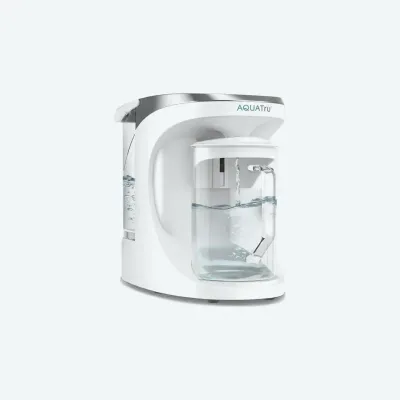
Reverse osmosis. AquaTru’s Classic and Carafe countertop units list a maximum hardness of 10 gpg (171 mg/L) on their data sheets, and AquaTru says its units are intended for water below that, because scale builds up on the membrane. 13 of the 27 utilities in the table above report water over 171 mg/L in at least part of their area or year: Salt Lake City, Santa Barbara, Indianapolis, Palm Springs, San Jose, Las Vegas, San Diego, Los Angeles, Corpus Christi, Houston, Tampa, Washington, DC and Ann Arbor. The AquaTru review covers descaling, and the hard water filters with their hardness limits are compared side by side.
Sodium. A salt-based softener trades hardness for sodium. Penn State puts it at 7.5 mg of sodium per quart for each gpg of hardness taken out, so softening 15 gpg water adds about 113 mg per quart. If you follow a low-sodium diet, ask your doctor before softening drinking water. This guide is general information, not medical advice. See our health disclaimer.
What a softener won’t do. Penn State notes that softening deals with a nuisance, not a health threat, and won’t necessarily fix more serious drinking water problems. A hardness result is one input, not a full water test.
On a private well, test hardness together with iron
A private well has no utility report, so a test is the only way to know. In a USGS study of about 2,100 domestic wells, hard water was common in the east-central and western United States, where carbonate rock and mineral-rich aquifers are widespread. Penn State lists a white or gray film, more soap use and a damaged water heater as signs to test for hardness, and orange-brown stains or a metallic taste as signs to test for iron and manganese.
Test iron at the same time. Penn State notes that iron exposed to air or chlorine clogs softener resin and should be filtered out before the softener. EPA’s private well page lists “water softener needed to treat hardness” as a symptom that points to manganese and iron. Strip kits usually read both, and Tap Score’s Essential Well Water Test lists hardness with 54 analytes, iron included, for $209 (checked Oct 14, 2026). For bacteria, nitrate and the rest of a yearly well check, see the well water testing guide.
Questions people ask
How can I measure my water hardness?
Check your utility’s yearly report first. At home, a test strip gives a color band and a drop-count kit gives a number in grains per gallon. A lab test gives a number in mg/L and gpg along with other results. On a private well, test it yourself, since there is no utility report.
What are the three types of hardness tests?
Test strips that change color, drop-count titration kits where you count drops until the sample turns blue, and lab analysis that calculates hardness from measured calcium and magnesium. Strips are the quickest, titration gives a number at home, and a lab adds other results.
Does TDS affect water hardness?
Calcium and magnesium are part of TDS, so very hard water usually has a high TDS, and EPA lists hardness among the effects of TDS above 500 mg/L. But TDS also counts sodium, chloride and other salts, so a TDS reading can’t be turned into a hardness number.
What causes water to be hard?
Calcium and magnesium dissolved from rock and soil. USGS explains that groundwater picks them up as it moves through the ground, so well water and cities on groundwater tend to be harder than places that draw on mountain reservoirs.
Is there a free hard water test?
Yes. Your utility’s yearly report may list hardness, Morton Salt mails a free test strip, and many water treatment dealers test for free. University extension services advise an independent test before you buy a softener on a dealer’s result.
What is the best hard water test kit?
For a number to size or set a softener, a drop-count kit or a lab test. For a quick check of hardness alongside other items, strips. Our water test kit picks compare strips and lab kits by price, turnaround and returns.
Ready to pick one?
I compare 9 water tests on lab or strips, what they measure, price, return terms and owner reviews. These score highest right now.